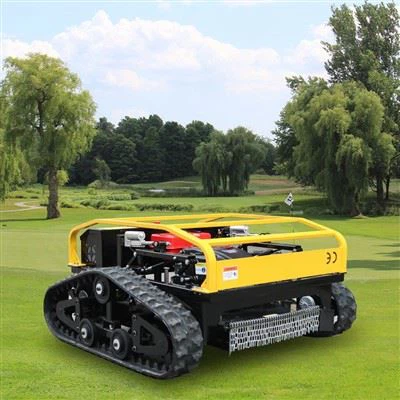
As a supplier of remote mowers, I am often asked about the features and capabilities of our products, especially whether they have a self - driving mode. In this blog post, I will delve into this topic, exploring the current state of self - driving technology in remote mowers, its benefits, limitations, and how our offerings fit into this landscape.
The Concept of Self - Driving in Remote Mowers
Self - driving technology in remote mowers represents a significant leap forward in lawn care automation. It aims to reduce the need for constant human intervention, allowing the mower to navigate a lawn autonomously, making it more efficient and convenient for users. The idea is to enable the mower to detect obstacles, follow a pre - defined path, and adjust its cutting pattern based on the terrain and grass conditions.
How Self - Driving Works
Self - driving remote mowers typically use a combination of sensors, such as GPS, LiDAR (Light Detection and Ranging), and cameras. GPS helps the mower to determine its position within the lawn area. It can be programmed to follow a specific route, ensuring that the entire lawn is covered evenly. LiDAR sensors emit laser beams to create a 3D map of the surrounding environment, detecting obstacles like trees, rocks, or garden furniture. Cameras can also be used to identify objects and provide visual feedback to the mower's control system.


Benefits of Self - Driving Remote Mowers
One of the primary advantages of self - driving remote mowers is increased efficiency. They can work continuously without breaks, covering large areas of lawn in a shorter time compared to manual mowing. This is especially beneficial for commercial properties, golf courses, and large residential lawns. Additionally, self - driving mowers can provide a more consistent cut, as they follow a pre - determined pattern, resulting in a neater and more professional - looking lawn.
Another benefit is safety. Since the mower can detect and avoid obstacles on its own, the risk of accidents is significantly reduced. This is particularly important in areas with children, pets, or other potential hazards. Moreover, self - driving technology can save labor costs, as less human supervision is required.
Our Remote Mowers and Self - Driving Capabilities
At our company, we offer a range of remote mowers with varying levels of self - driving functionality. Our Remote Control Lawn Mower With Tracks is designed for tough terrains and can be equipped with advanced sensors for obstacle detection. While it doesn't have a fully autonomous self - driving mode in the traditional sense, it does offer semi - autonomous features. For example, it can be programmed to follow a straight line or a simple pattern, reducing the amount of manual control needed.
Our Remote Control Grass Cutter is another product that incorporates some self - driving elements. It has sensors that can detect changes in the grass height and adjust the cutting height accordingly. This ensures a more uniform cut across the lawn. Although it still requires some level of remote control input, these features make the mowing process more efficient and user - friendly.
The Remote Control Rotary Lawn Mower Automatic Robot Lawnmower is our most advanced offering in terms of self - driving capabilities. It uses a combination of GPS and LiDAR sensors to navigate the lawn autonomously. The user can define the boundaries of the lawn using a virtual fence, and the mower will stay within those boundaries while mowing. It can also detect and avoid obstacles, making it a great option for those looking for a hands - off lawn care solution.
Limitations of Self - Driving Remote Mowers
Despite the many benefits, self - driving remote mowers also have some limitations. One of the main challenges is the complexity of the environment. Lawns can have uneven terrain, slopes, and hidden obstacles, which can pose difficulties for the mower's sensors. For example, tall grass or thick vegetation may interfere with the LiDAR or camera sensors, causing the mower to misinterpret the environment.
Another limitation is the cost. Self - driving technology adds to the manufacturing cost of the mower, making it more expensive for consumers. This can be a deterrent for some customers, especially those with smaller lawns or on a tight budget. Additionally, the technology is still evolving, and there may be occasional glitches or malfunctions in the self - driving system.
Future Developments
The future of self - driving remote mowers looks promising. As technology continues to advance, we can expect to see more accurate sensors, better obstacle detection algorithms, and improved battery life. This will make the mowers more reliable and efficient. In the coming years, we may also see the integration of artificial intelligence and machine learning, allowing the mowers to learn from their environment and adapt their mowing patterns over time.
Conclusion
In conclusion, while self - driving remote mowers are not yet perfect, they offer a lot of potential for the future of lawn care. Our company is committed to providing high - quality remote mowers with varying levels of self - driving functionality to meet the diverse needs of our customers. Whether you are a homeowner looking for a convenient way to maintain your lawn or a commercial property owner in need of an efficient mowing solution, we have a product that can suit your requirements.
If you are interested in learning more about our remote mowers or would like to discuss a potential purchase, please feel free to contact us. We are always happy to answer your questions and provide you with more information about our products.
References
- "Autonomous Lawn Mowers: A Review of Current Technologies and Future Trends" - Journal of Agricultural Engineering
- "The Impact of Self - Driving Technology on the Lawn Care Industry" - Landscape Management Magazine