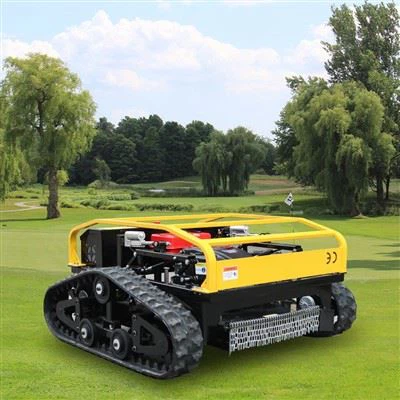
As a supplier of remote mowers, I understand the importance of battery health for the optimal performance of these machines. A well - maintained battery ensures that your remote mower can operate efficiently, cover a larger area, and have a longer lifespan. In this blog, I'll share some effective ways to check the battery health of a remote mower.
1. Visual Inspection
The first step in checking the battery health of a remote mower is a simple visual inspection. This can reveal a lot about the battery's condition.
- Physical Damage: Look for any signs of physical damage on the battery case, such as cracks, dents, or bulges. A cracked or dented battery can be a sign of internal damage, while a bulge often indicates that the battery has overheated or is experiencing a chemical imbalance. For example, if you notice a bulge on the side of the lithium - ion battery of your Remote Control Mower, it's a clear indication that the battery is in a dangerous state and should be replaced immediately.
- Corrosion: Check the battery terminals for corrosion. Corrosion on the terminals can impede the flow of electricity, reducing the battery's ability to charge and discharge properly. If you see a white or greenish - blue powdery substance on the terminals, it's corrosion. You can clean the terminals with a mixture of baking soda and water and a wire brush, but if the corrosion is severe, it may be a sign of a more serious battery problem.
2. Battery Voltage Check
Measuring the battery voltage is a crucial step in assessing its health. You'll need a multimeter for this task.
- Fully Charged Voltage: First, make sure the battery is fully charged. For most lithium - ion batteries used in remote mowers, a fully charged voltage should be around 3.6 - 3.7 volts per cell. If your battery has multiple cells connected in series, you need to multiply this voltage by the number of cells. For example, a 4 - cell lithium - ion battery should have a fully charged voltage of approximately 14.4 - 14.8 volts.
- Resting Voltage: After charging, let the battery rest for a few hours. Then, measure the resting voltage. A significant drop in the resting voltage compared to the fully charged voltage may indicate a problem with the battery. If the voltage drops rapidly, it could mean that the battery is losing its ability to hold a charge, which might be due to factors like internal short - circuits or aging cells.
- Load Voltage: You can also measure the voltage while the remote mower is in operation. A healthy battery should maintain a relatively stable voltage under load. If the voltage drops significantly when the mower is running, it means the battery is struggling to supply the necessary power, which could be a sign of a weak battery.
3. Battery Capacity Test
The battery capacity is a measure of how much energy the battery can store. To test the capacity, you'll need to perform a discharge test.
- Using a Discharge Tester: There are specialized discharge testers available in the market. These testers allow you to discharge the battery at a controlled rate and measure the total amount of energy it can deliver. You can compare the measured capacity with the battery's rated capacity. For example, if a battery is rated at 5000 mAh but your discharge test shows a capacity of only 3000 mAh, it means the battery has lost a significant amount of its capacity and may need to be replaced.
- Runtime Test: Another way to estimate the battery capacity is by conducting a runtime test. Fully charge the battery and then run the remote mower under normal operating conditions until the battery is completely depleted. Record the running time. If the running time is significantly shorter than when the battery was new, it indicates a loss of capacity. However, this method is less accurate as it can be affected by factors such as the terrain, grass thickness, and the mower's operating speed.
4. Battery Temperature Monitoring
Temperature plays a vital role in battery health. Extreme temperatures can damage the battery and reduce its lifespan.


- Charging Temperature: When charging the battery, make sure the temperature is within the recommended range. Most lithium - ion batteries should be charged at a temperature between 0°C and 45°C. Charging the battery at temperatures outside this range can cause damage to the battery cells and reduce its capacity over time.
- Operating Temperature: Monitor the battery temperature during operation. If the battery gets too hot during use, it can be a sign of overloading or a problem with the battery's internal resistance. You can use an infrared thermometer to measure the battery temperature. If the temperature exceeds 60°C, stop using the mower immediately and let the battery cool down.
5. Battery Management System (BMS) Check
Many modern remote mowers are equipped with a Battery Management System (BMS). The BMS is responsible for monitoring and protecting the battery.
- Error Codes: Check if the BMS has any error codes. Some BMS systems can display error codes on a built - in display or communicate with the mower's control system. These error codes can indicate various problems, such as over - charging, over - discharging, or a short - circuit. Refer to the mower's user manual to understand what each error code means and how to address the issue.
- Functionality: Test the BMS's functionality. The BMS should be able to balance the charge between the battery cells, prevent over - charging and over - discharging, and protect the battery from short - circuits. If you suspect that the BMS is not working properly, it's advisable to have it checked by a professional.
6. Manufacturer's Diagnostic Tools
Some remote mower manufacturers provide their own diagnostic tools or software. These tools can offer more in - depth information about the battery's health.
- Software Updates: Make sure your mower's software is up - to - date. Manufacturers often release software updates that can improve the battery management and diagnostic capabilities.
- Diagnostic Reports: Use the manufacturer's diagnostic tools to generate reports about the battery's health. These reports may include information such as the number of charge cycles, the battery's state of health (SOH), and any detected faults.
7. Comparing with New Batteries
If possible, compare the performance of the battery in question with a new battery of the same type.
- Runtime and Power: Run both batteries under the same conditions and compare their runtime and power output. If the old battery has a significantly shorter runtime or less power, it's a clear indication that its health has deteriorated.
- Charging Time: Compare the charging times of the two batteries. A healthy battery should charge within a reasonable time frame. If the old battery takes much longer to charge, it may be a sign of a problem.
Conclusion
Regularly checking the battery health of your remote mower is essential for its proper functioning and longevity. By following the methods described above, you can identify potential battery problems early and take appropriate measures, such as replacing the battery or performing maintenance.
If you're in the market for a high - quality Remote Control Rotary Lawn Mower Automatic Robot Lawnmower or Remote Control Mower, we are here to provide you with top - notch products. Our remote mowers are equipped with high - performance batteries and advanced battery management systems to ensure optimal performance. We invite you to contact us for procurement and discuss how our products can meet your lawn - mowing needs.
References
- Battery University. A comprehensive resource for battery knowledge and testing methods.
- Remote mower user manuals. These manuals often contain specific information about battery maintenance and testing for each model.