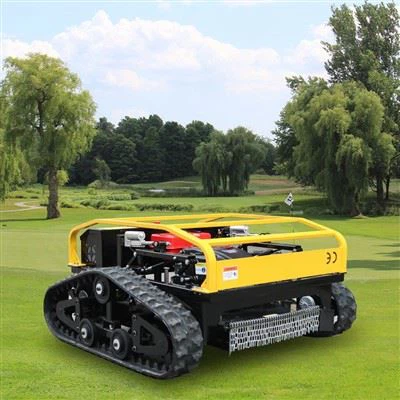
In the world of modern lawn care, remote mowers have emerged as a revolutionary tool, offering convenience, efficiency, and precision like never before. As a leading supplier of remote mowers, I am often asked about how these remarkable machines work. In this blog post, I will delve into the fascinating technology behind the remote control of a remote mower, exploring the key components and processes that make it all possible.
The Basics of Remote Control Technology
At the heart of every remote mower is a sophisticated remote control system that allows the operator to control the machine from a distance. This system typically consists of two main components: a handheld transmitter and a receiver unit installed on the mower itself.
The handheld transmitter is the device that the operator uses to send commands to the mower. It is equipped with a series of buttons, switches, and joysticks that correspond to different functions of the mower, such as starting and stopping the engine, controlling the speed and direction of movement, and activating the cutting blades. When the operator presses a button or moves a joystick on the transmitter, it sends a signal to the receiver unit on the mower.
The receiver unit is responsible for receiving the signals sent by the transmitter and translating them into actions that the mower can understand. It is typically connected to the mower's control system, which includes the engine, the drive motors, and the cutting blades. When the receiver unit receives a signal from the transmitter, it sends a corresponding command to the control system, which then activates the appropriate function of the mower.
Wireless Communication Technology
The communication between the handheld transmitter and the receiver unit on the mower is typically wireless, which allows the operator to control the mower from a distance without the need for a physical connection. There are several different types of wireless communication technologies that can be used in remote mowers, including radio frequency (RF) and infrared (IR).
RF technology is the most commonly used wireless communication technology in remote mowers. It uses radio waves to transmit signals between the transmitter and the receiver unit, which allows for a longer range of communication and better resistance to interference. RF signals can be transmitted over a distance of several hundred feet, depending on the power of the transmitter and the environment in which the mower is being used.
IR technology, on the other hand, uses infrared light to transmit signals between the transmitter and the receiver unit. It is typically used in applications where a shorter range of communication is required, such as in indoor environments or in close proximity to the mower. IR signals are more susceptible to interference from other sources of light, such as sunlight or artificial lighting, which can limit their effectiveness in certain situations.
Control Systems and Sensors
In addition to the wireless communication technology, remote mowers also rely on a sophisticated control system and a variety of sensors to ensure safe and efficient operation. The control system is responsible for managing the various functions of the mower, such as the engine, the drive motors, and the cutting blades, based on the commands received from the transmitter.
One of the key components of the control system is the microcontroller, which is a small computer that is programmed to perform specific tasks. The microcontroller receives the signals from the receiver unit and processes them to determine the appropriate actions to take. It then sends commands to the various components of the mower, such as the engine control unit, the drive motor controllers, and the cutting blade controllers, to activate the desired functions.
The sensors on the mower play an important role in ensuring safe and efficient operation. They are used to detect various parameters, such as the speed, direction, and position of the mower, as well as the presence of obstacles or other hazards. The sensors send this information to the control system, which can then adjust the operation of the mower accordingly.
For example, if the sensors detect an obstacle in the path of the mower, the control system can automatically stop the mower and reverse its direction to avoid a collision. Similarly, if the sensors detect that the mower is approaching the edge of a cliff or other dangerous area, the control system can activate a safety feature to prevent the mower from falling off.


Power and Battery Management
Another important aspect of the remote control of a remote mower is power and battery management. Remote mowers are typically powered by rechargeable batteries, which provide a clean and efficient source of energy. However, the batteries need to be carefully managed to ensure that they have enough power to operate the mower for the desired period of time.
The control system on the mower is responsible for monitoring the battery level and managing the power consumption of the various components of the mower. It can adjust the speed and operation of the engine, the drive motors, and the cutting blades to conserve energy and extend the battery life. In addition, the control system can also provide an alert to the operator when the battery level is low, indicating that it is time to recharge the batteries.
Applications and Benefits of Remote Mowers
Remote mowers have a wide range of applications in various industries and settings. In the residential sector, they are often used to mow large lawns or yards, especially those with difficult terrain or obstacles. They can also be used to mow lawns in areas that are difficult to access, such as steep slopes or narrow passages.
In the commercial sector, remote mowers are used in a variety of applications, such as golf courses, parks, cemeteries, and sports fields. They can provide a more efficient and precise way of mowing large areas of grass, reducing the time and labor required for manual mowing. In addition, remote mowers can also be used in hazardous or dangerous environments, such as near power lines or in areas with high levels of noise or pollution.
The benefits of using remote mowers are numerous. They offer a high level of convenience, allowing the operator to control the mower from a safe and comfortable distance. They also provide a more efficient and precise way of mowing, reducing the time and labor required for manual mowing. In addition, remote mowers can be used in a variety of environments and settings, making them a versatile and practical tool for lawn care professionals and homeowners alike.
Conclusion
In conclusion, the remote control of a remote mower is a complex and sophisticated technology that relies on a combination of wireless communication, control systems, sensors, and power management to ensure safe and efficient operation. As a leading supplier of remote mowers, we are committed to providing our customers with the highest quality products and the latest technology in lawn care.
If you are interested in learning more about our Remote Control Mower or would like to discuss your specific lawn care needs, please do not hesitate to contact us. We would be happy to provide you with more information and to help you find the right remote mower for your needs.
References
- "Introduction to Remote Control Technology." Electronics Tutorials.
- "Wireless Communication Technologies for Remote Control Systems." IEEE Transactions on Wireless Communications.
- "Control Systems and Sensors in Remote Mowers." Journal of Agricultural Engineering Research.
- "Power and Battery Management in Remote Mowers." Renewable Energy.