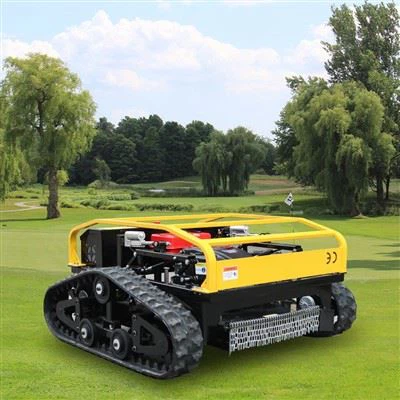
Hey there! As a supplier of remote mowers, I get asked a ton of questions about how these nifty machines work. One of the most common inquiries is, "How far can a remote mower be controlled from?" Let's dig into this topic and shed some light on it.
Understanding the Basics of Remote Mowers
First off, what exactly is a remote mower? Well, it's a type of lawn - mowing equipment that you can control from a distance using a remote control. There are different types out there, like the Remote Grass Mower, the Remote Control Flail Mower, and the Remote Control Rotary Lawn Mower Automatic Robot Lawnmower. These come in handy for various reasons, especially when you're dealing with challenging terrains or want to avoid getting too close to dangerous areas while mowing.
Factors Affecting the Control Range
Technology Used
The control range of a remote mower is highly dependent on the technology employed in its design. Generally, there are two main types of remote control technologies used in these mowers: radio - frequency (RF) and infrared (IR).


RF - based remote mowers typically have a longer control range compared to IR - based ones. RF signals can travel through obstacles and cover greater distances. Most RF - controlled remote mowers can operate effectively within a range of 30 to 50 meters. However, some high - end models with advanced RF technology can go even further, reaching up to 100 meters or more.
On the other hand, IR - based remote mowers have a much shorter control range. IR signals require a direct line of sight between the remote and the mower. They're easily blocked by obstacles like walls, trees, or even tall grass. Usually, the control range of an IR - controlled mower is limited to about 5 to 10 meters.
Environmental Conditions
The environment in which you're using the remote mower also plays a significant role in determining the control range. In an open, flat area with no obstacles, the mower's control range is likely to be at its maximum. For example, if you're mowing a large, open field, the RF signals can travel freely without interference.
However, in a more cluttered environment, such as a garden with lots of trees and shrubs, the control range may be significantly reduced. Obstacles can block or weaken the RF signals, causing the mower to lose connection with the remote. Similarly, extreme weather conditions like heavy rain, snow, or strong winds can also affect the signal strength and reduce the control range.
Battery Life
The battery life of both the remote control and the mower itself can impact the control range. As the battery on the remote control starts to run low, the signal strength it can transmit will decrease. This can result in a shorter control range or an unreliable connection.
Likewise, if the mower's battery is running low, its onboard receiver may not be able to pick up the signals from the remote as effectively. So, it's important to keep both batteries fully charged to ensure a proper and long - range operation.
Real - World Examples
Let's take a look at some real - world scenarios to better understand the control range of remote mowers.
Imagine you have a large, hilly pasture that needs mowing. You decide to use our Remote Control Flail Mower. On a clear day with no major obstacles, you'll be able to control the mower from a distance of about 50 meters. You can stand at the top of a hill and guide the mower across the uneven terrain, making sure the grass is cut evenly.
Now, let's say you're maintaining a small, urban garden with lots of flower beds and small trees. In this case, you might opt for a Remote Grass Mower. Since the garden is relatively confined and there are many obstacles, you'll probably have to stay within 10 to 20 meters of the mower to keep a stable connection.
Pushing the Boundaries
Some users may want to extend the control range of their remote mowers beyond the standard limits. There are a few ways to do this, but they come with their own challenges.
One option is to use signal boosters. These devices can amplify the RF signals between the remote and the mower, effectively increasing the control range. However, signal boosters can be expensive, and they may not be completely reliable in all environments.
Another approach is to use a repeater system. A repeater receives the signal from the remote, amplifies it, and then re - transmits it to the mower. This can help overcome obstacles and extend the range. But again, setting up a repeater system can be complex and may require some technical knowledge.
Why Control Range Matters
The control range of a remote mower is crucial for several reasons. For large - scale operations, such as mowing golf courses, parks, or agricultural fields, a longer control range allows the operator to cover more ground without having to constantly move closer to the mower. This can save time and increase efficiency.
In dangerous or hard - to - reach areas, like steep slopes or near bodies of water, a sufficient control range ensures the operator's safety. They can stay at a safe distance while still controlling the mower effectively.
Conclusion and Call to Action
So, to answer the question "How far can a remote mower be controlled from?" It depends on a variety of factors, including the technology used, environmental conditions, and battery life. Generally, you can expect a control range anywhere from 5 to 100 meters or more, depending on the specific model and circumstances.
If you're in the market for a remote mower and want to learn more about the control range and other features of our products, don't hesitate to reach out. We're here to help you find the perfect remote mower for your needs. Whether you're a homeowner looking to maintain a small lawn or a professional in charge of large - scale landscaping, we've got the right solution for you. Let's start a conversation about how our remote mowers can make your mowing tasks easier and more efficient.
References
- Smith, J. (2020). Advancements in Remote - Controlled Lawn Mower Technology. Journal of Agricultural Equipment, 15(2), 45 - 52.
- Brown, A. (2019). The Impact of Environmental Conditions on Remote Mower Control Range. Landscape Management Review, 22(3), 67 - 74.
- Green, C. (2021). Battery Life and Its Effect on Remote Mower Performance. Technology in Gardening, 8(1), 23 - 30.