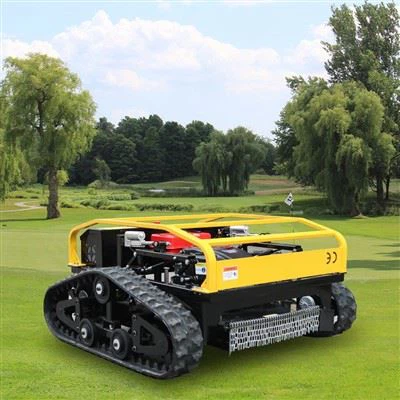
Hey there! As a supplier of remote mowers, I often get asked if these nifty machines are suitable for commercial use. Well, let's dive right into it and break down the ins and outs of using remote mowers in a commercial setting.
First off, what exactly is a remote mower? There are different types, like the Robotic Lawn Mower, Remote Control Flail Mower, and Remote Grass Mower. These mowers can be controlled from a distance, which offers a whole bunch of advantages for commercial applications.
Advantages of Remote Mowers for Commercial Use
1. Safety
One of the biggest perks of using remote mowers commercially is safety. In commercial lawn - care operations, there are often tricky terrains and hazardous areas. For example, steep slopes, areas near water bodies, or sites with debris. With a remote mower, operators can stay at a safe distance while the mower does its job. This reduces the risk of accidents, such as falls on uneven ground or collisions with obstacles. It also protects workers from exposure to harmful chemicals if the mower is used in areas where pesticides or fertilizers have been applied.
2. Efficiency
Remote mowers can significantly boost efficiency in commercial lawn - care. They can be programmed to follow specific patterns, ensuring that every inch of the lawn is mowed evenly. This eliminates the need for manual re - mowing of missed spots. Moreover, these mowers can work continuously without breaks, unlike human operators. They can be set to start and stop at specific times, allowing for better time management. For large commercial properties like golf courses or corporate parks, this can save a huge amount of time and labor costs.
3. Precision
When it comes to commercial landscaping, precision is key. Remote mowers offer a high level of accuracy in cutting. They can be adjusted to cut at different heights, depending on the type of grass and the client's requirements. This is especially important for areas where a uniform appearance is desired, such as sports fields or manicured gardens. The ability to control the mower's movement precisely also means that it can navigate around trees, flower beds, and other obstacles with ease, leaving a clean and professional finish.


4. Adaptability
Remote mowers are highly adaptable to different types of terrains and grass conditions. Whether it's a flat, open lawn or a hilly, rough area, they can handle it all. Some models are equipped with special features like all - terrain wheels or tracks, which allow them to move smoothly on various surfaces. This makes them suitable for a wide range of commercial applications, from small business front yards to large rural estates.
Disadvantages of Remote Mowers for Commercial Use
1. Initial Cost
The biggest drawback of using remote mowers commercially is the initial investment. These machines are generally more expensive than traditional push or ride - on mowers. The cost includes not only the purchase price of the mower but also any additional equipment needed for programming and control. For small commercial lawn - care businesses with limited budgets, this can be a significant barrier to entry.
2. Technical Complexity
Remote mowers rely on advanced technology, which can be a double - edged sword. While it offers many benefits, it also means that there is a learning curve for operators. They need to be trained on how to operate the mower, program its functions, and troubleshoot any technical issues that may arise. This requires time and resources, and if not done properly, it can lead to inefficiencies and breakdowns.
3. Maintenance
Maintaining a remote mower can be more complicated than a traditional mower. The electronic components and sensors need to be regularly checked and calibrated to ensure proper functioning. Batteries, if used, need to be replaced periodically. Additionally, the mower's blades and other mechanical parts also require routine maintenance. This can add to the overall cost of ownership and may require specialized knowledge or the services of a professional technician.
4. Limited Battery Life
Most remote mowers are battery - powered. While battery technology has improved over the years, the battery life of these mowers can still be a limitation, especially for large commercial properties. If the mower runs out of power in the middle of a job, it can disrupt the workflow and cause delays. This may require the use of multiple batteries or a charging station on - site, which adds to the complexity and cost.
Factors to Consider Before Going Commercial with Remote Mowers
1. Property Size and Terrain
The size and terrain of the commercial properties you plan to service are crucial factors. For small to medium - sized, relatively flat properties, a remote mower can be a great fit. However, for extremely large or highly irregular terrains, you may need to evaluate whether a remote mower can cover the area efficiently. In some cases, a combination of remote mowers and traditional mowers may be the best solution.
2. Budget
As mentioned earlier, the initial cost and ongoing maintenance of remote mowers are significant considerations. You need to assess your budget and determine if the long - term savings in labor and increased efficiency justify the upfront investment. It's also important to factor in the cost of training your staff and any additional equipment you may need.
3. Client Expectations
Understanding your clients' expectations is essential. Some clients may have specific requirements regarding the appearance of their lawns, the frequency of mowing, or the use of certain mowing techniques. Make sure that a remote mower can meet these expectations. Communicate with your clients about the benefits and limitations of using a remote mower to manage their expectations.
4. Local Regulations
Before using remote mowers commercially, it's important to check local regulations. Some areas may have restrictions on the use of automated or remote - controlled equipment, especially in public spaces or areas near residential neighborhoods. Make sure you comply with all relevant laws and regulations to avoid any legal issues.
Conclusion
So, is a remote mower suitable for commercial use? The answer is that it depends. There are clear advantages in terms of safety, efficiency, precision, and adaptability. However, there are also challenges, such as high initial costs, technical complexity, maintenance requirements, and limited battery life. By carefully considering factors like property size, budget, client expectations, and local regulations, commercial lawn - care businesses can make an informed decision.
If you're in the commercial lawn - care industry and are thinking about incorporating remote mowers into your operations, I'd love to have a chat with you. We can discuss which type of remote mower would be the best fit for your specific needs. Whether it's a Robotic Lawn Mower, Remote Control Flail Mower, or Remote Grass Mower, we have a range of options to choose from. Contact us to start a conversation about how remote mowers can take your commercial lawn - care business to the next level.
References
- "The Future of Lawn Care: Remote - Controlled Mowers" - Journal of Commercial Landscaping
- "Safety and Efficiency in Lawn - Care Operations" - International Journal of Occupational Safety and Health
- "Precision Landscaping with Remote Mowers" - Landscape Architecture Magazine