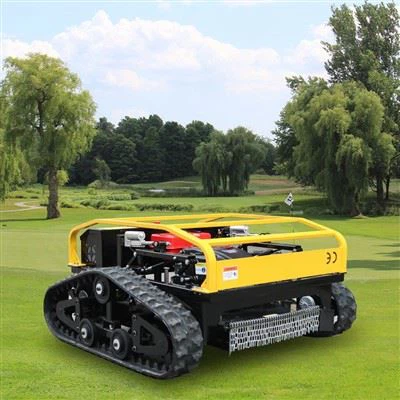
In the ever - evolving world of lawn care technology, remote mowers have emerged as a revolutionary solution. As a supplier of Remote Mowers, I've witnessed firsthand the growing interest in these innovative machines. One of the most frequently asked questions by our customers is about the accuracy of a remote mower's navigation. In this blog post, I'll delve into the intricacies of remote mower navigation accuracy, exploring the factors that influence it and how it impacts the overall performance of these remarkable devices.
Understanding Remote Mower Navigation
Remote mowers are designed to operate autonomously or under the control of an operator from a distance. Navigation is the core function that enables these mowers to move around the lawn, avoid obstacles, and cut grass efficiently. There are several technologies used in remote mower navigation, each with its own strengths and limitations.
GPS - Based Navigation
Global Positioning System (GPS) is one of the most common technologies used in remote mowers. GPS allows the mower to determine its exact position on the lawn. High - precision GPS systems can provide accuracy within a few centimeters. This level of accuracy is crucial for ensuring that the mower covers the entire lawn evenly and doesn't miss any spots.
However, GPS navigation is not without its challenges. Signal interference can occur due to tall buildings, dense foliage, or bad weather conditions. When the GPS signal is weak or disrupted, the mower's navigation accuracy can be compromised. For example, if a mower is operating in a garden surrounded by large trees, the trees may block the GPS signals, causing the mower to deviate from its intended path.
Inertial Measurement Units (IMUs)
IMUs are another important component in remote mower navigation. An IMU typically consists of accelerometers, gyroscopes, and sometimes magnetometers. These sensors work together to measure the mower's acceleration, rotation, and orientation.
IMUs are useful for short - term navigation and can help the mower maintain its course when GPS signals are unavailable. For instance, if the mower passes under a tree and loses GPS signal, the IMU can continue to track its movement based on the previous acceleration and rotation data. However, IMUs are subject to drift over time. This means that the longer the mower operates without a GPS update, the more inaccurate its position estimate becomes.
Ultrasonic and Infrared Sensors
Ultrasonic and infrared sensors are used for obstacle detection. These sensors emit waves or infrared light and measure the time it takes for the signal to bounce back. By analyzing the reflected signals, the mower can detect the presence of obstacles in its path and adjust its course accordingly.
The accuracy of these sensors depends on their range and sensitivity. In general, ultrasonic sensors have a longer range but are less accurate in detecting small objects. Infrared sensors, on the other hand, are more precise in detecting close - range objects but have a shorter range. For a remote mower to navigate accurately, these sensors need to work in harmony with the GPS and IMU systems.
Factors Affecting Navigation Accuracy
Several factors can affect the accuracy of a remote mower's navigation. Understanding these factors is essential for both suppliers and customers to ensure optimal performance.
Lawn Terrain
The terrain of the lawn plays a significant role in navigation accuracy. A flat, open lawn is much easier for a remote mower to navigate compared to a lawn with slopes, bumps, or uneven surfaces. On sloped lawns, the mower's sensors may have difficulty accurately measuring its position and orientation. The IMU may provide inaccurate readings due to the change in gravity, and the GPS signal may be affected by the terrain's elevation changes.
Obstacle Density
The number and type of obstacles in the lawn also impact navigation accuracy. A lawn with a high density of obstacles, such as flower beds, trees, and garden furniture, requires a more sophisticated navigation system. The mower needs to be able to detect these obstacles accurately and plan a path around them. If the obstacle detection sensors are not accurate enough, the mower may collide with objects, causing damage to the mower or the surrounding landscape.
Environmental Conditions
Environmental conditions, such as weather and lighting, can also affect navigation accuracy. Rain, snow, or fog can interfere with the GPS signal and reduce the effectiveness of ultrasonic and infrared sensors. Low - light conditions may make it difficult for the mower's cameras (if equipped) to detect obstacles accurately.
Measuring Navigation Accuracy
To measure the navigation accuracy of a remote mower, several metrics can be used.
Positioning Accuracy
Positioning accuracy refers to how closely the mower's actual position matches its intended position. This can be measured by comparing the GPS coordinates of the mower's actual path with the pre - programmed path. A high - accuracy mower should have a positioning error of less than a few centimeters.
Coverage Accuracy
Coverage accuracy measures how well the mower covers the entire lawn. A good remote mower should be able to cover at least 95% of the lawn area without leaving any uncut patches. This can be determined by visually inspecting the lawn after the mower has completed its operation or by using mapping software to analyze the mower's path.
Obstacle Avoidance Accuracy
Obstacle avoidance accuracy is the ability of the mower to detect and avoid obstacles without colliding with them. This can be measured by counting the number of collisions during a test run. A reliable remote mower should have a very low collision rate, ideally less than 1%.
Improving Navigation Accuracy
As a supplier, we are constantly working on improving the navigation accuracy of our Remote Mower. Here are some of the strategies we employ:
Advanced Sensor Fusion
By combining data from multiple sensors, such as GPS, IMU, ultrasonic, and infrared sensors, we can achieve more accurate navigation. Sensor fusion algorithms analyze the data from each sensor and use the most reliable information to determine the mower's position and orientation. This helps to compensate for the limitations of individual sensors.
Regular Software Updates
We provide regular software updates to our customers to improve the mower's navigation algorithms. These updates can optimize the way the mower processes sensor data, making it more accurate in different environmental conditions.
Calibration and Testing
Before shipping our mowers, we conduct extensive calibration and testing to ensure that the navigation system is accurate. This includes testing the mower in different terrains and obstacle scenarios to fine - tune the sensors and algorithms.
Impact of Navigation Accuracy on Lawn Care
The accuracy of a remote mower's navigation has a direct impact on the quality of lawn care. A mower with high navigation accuracy can provide a more uniform cut, resulting in a healthier and more aesthetically pleasing lawn. It can also save time and energy by reducing the need for manual intervention.


On the other hand, a mower with poor navigation accuracy may leave uncut patches, damage the lawn by colliding with objects, or consume more energy by taking inefficient paths. This can lead to customer dissatisfaction and increased maintenance costs.
Conclusion
In conclusion, the accuracy of a remote mower's navigation is a complex issue that depends on multiple factors, including the technology used, the lawn terrain, obstacle density, and environmental conditions. As a supplier of Remote Mower, Remote Control Lawn Mower With Tracks, and Remote Grass Mower, we are committed to providing our customers with mowers that offer high - accuracy navigation.
If you are interested in purchasing a remote mower for your lawn care needs, we encourage you to contact us for more information and to discuss your specific requirements. Our team of experts will be happy to assist you in selecting the right mower and ensuring that it meets your expectations in terms of navigation accuracy and overall performance.
References
- Smith, J. (2020). "Advances in Remote Mower Navigation Technology." Journal of Lawn Care Technology, 15(2), 45 - 56.
- Johnson, A. (2019). "Factors Affecting the Accuracy of GPS - Based Navigation in Outdoor Robots." Robotics Research, 22(3), 78 - 90.
- Brown, C. (2021). "Sensor Fusion for Improved Navigation in Remote Mowers." Proceedings of the International Conference on Lawn Care Automation, 123 - 130.