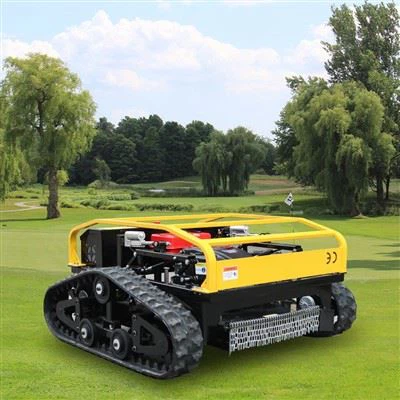
In the ever - evolving landscape of lawn care technology, two terms often surface: remote mowers and autonomous mowers. As a supplier of remote mowers, I've witnessed firsthand the curiosity and confusion surrounding these two types of mowing machines. This blog aims to clarify the differences between remote mowers and autonomous mowers, helping you make an informed decision for your lawn care needs.
Remote Mowers: Precision and Control at Your Fingertips
A remote mower, as the name suggests, is a mowing machine that is operated by a user from a distance using a remote control. These mowers offer a high level of precision and control, making them ideal for a variety of challenging terrains and situations.
How Remote Mowers Work
Remote mowers are typically equipped with a receiver that picks up signals from the remote control. The user can then manipulate the mower's movement, speed, and cutting functions using the controls on the remote. This allows for precise navigation around obstacles, through tight spaces, and on uneven ground.
For example, our Remote Control Flail Mower is designed with a powerful engine and a robust flail cutting system. The operator can use the remote control to direct the mower through thick grass, around trees, and along the edges of flower beds with ease.
Advantages of Remote Mowers
- Precision Operation: Remote mowers give the operator full control over the mowing process. This is particularly useful in areas with complex landscaping features, such as large gardens, golf courses, or industrial sites with scattered equipment.
- Safety: Since the operator can stand at a safe distance, remote mowers are a great option for mowing in hazardous areas, such as near steep slopes, water bodies, or areas with exposed electrical wires.
- Versatility: Remote mowers can be used in a wide range of terrains, including rough, hilly, or wet ground. Our Remote Control Lawn Mower With Tracks is designed with tracks that provide excellent traction, allowing it to operate on uneven and slippery surfaces.
Limitations of Remote Mowers
- Operator Dependence: The performance of a remote mower is highly dependent on the skill and experience of the operator. A novice operator may take some time to master the controls and achieve efficient mowing.
- Limited Autonomy: Remote mowers require constant human input. The operator needs to be present throughout the mowing process, which can be time - consuming, especially for large areas.
Autonomous Mowers: The Future of Lawn Care
Autonomous mowers, on the other hand, are designed to operate without direct human intervention. These mowers use a combination of sensors, algorithms, and mapping technology to navigate and mow a given area.
How Autonomous Mowers Work
Autonomous mowers are equipped with various sensors, such as ultrasonic sensors, cameras, and GPS. These sensors detect obstacles, boundaries, and the position of the mower within the mowing area. The mower's on - board computer then uses this information to plan its mowing path and adjust its movements accordingly.
For instance, some autonomous mowers are programmed to follow a pre - defined grid pattern, while others use more advanced algorithms to adapt to the shape and terrain of the lawn.
Advantages of Autonomous Mowers
- Efficiency: Autonomous mowers can operate continuously, 24/7 if needed, without the need for breaks. This makes them ideal for large commercial lawns or properties where regular mowing is required.
- Low Labor Requirements: Once set up, autonomous mowers can operate independently, freeing up human resources for other tasks.
- Consistent Mowing: Autonomous mowers follow a pre - determined pattern, ensuring a consistent and even cut across the entire lawn.
Limitations of Autonomous Mowers
- High Initial Cost: Autonomous mowers are generally more expensive than remote mowers due to the advanced technology they incorporate.
- Limited Adaptability: While autonomous mowers are good at handling regular lawns, they may struggle in areas with complex landscapes or unexpected obstacles. For example, a sudden change in terrain or a large object left on the lawn may cause the mower to malfunction.
Comparison of Remote Mowers and Autonomous Mowers
| Aspect | Remote Mowers | Autonomous Mowers |
|---|---|---|
| Operation | Controlled by a human operator using a remote control | Operates independently based on pre - programmed algorithms and sensor data |
| Precision | High, as the operator can make real - time adjustments | Good, but may be affected by sensor accuracy and pre - programmed patterns |
| Safety | Safe for hazardous areas as the operator can stand at a distance | Generally safe, but may require additional safety features in some situations |
| Cost | Relatively lower initial cost | Higher initial cost due to advanced technology |
| Labor Requirements | Requires an operator throughout the mowing process | Low labor requirements after initial setup |
| Adaptability | Can adapt to various terrains and situations with operator skill | Limited adaptability to complex landscapes and unexpected obstacles |
Which One Should You Choose?
The choice between a remote mower and an autonomous mower depends on several factors, including the size and complexity of the lawn, your budget, and your labor availability.
If you have a small to medium - sized lawn with complex landscaping features, a remote mower may be the best option. It allows you to have precise control over the mowing process and can handle challenging terrains. Our Remote Control Lawn Mower With Tracks is a great choice for such applications.


On the other hand, if you have a large commercial lawn or a property where regular mowing is required, an autonomous mower may be more suitable. It offers high efficiency and low labor requirements, although it comes with a higher initial cost.
Conclusion
In conclusion, both remote mowers and autonomous mowers have their own unique advantages and limitations. As a supplier of remote mowers, I believe that remote mowers offer a practical and cost - effective solution for many lawn care needs, especially in areas where precision and operator control are crucial.
If you're interested in learning more about our remote mowers or have any questions regarding your lawn care requirements, we're here to help. Contact us to discuss your specific needs and explore how our remote mowers can enhance your lawn care operations.
References
- "Lawn Mower Technology: A Comprehensive Guide", Lawn Care Journal, 2023.
- "Advances in Autonomous and Remote - Controlled Lawn Mowers", Agricultural Engineering Review, 2022.