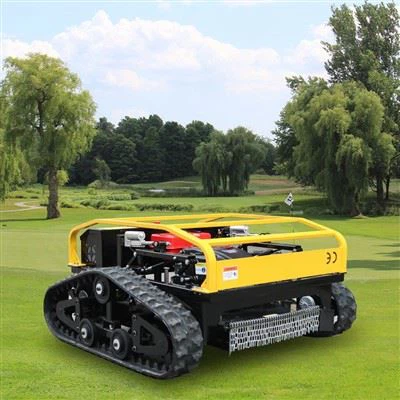
What is the Obstacle Detection System of a Remote Mower?
As a supplier of remote mowers, I've witnessed firsthand the remarkable evolution of these machines. One of the most crucial aspects of a remote mower is its obstacle detection system. In this blog, I'll delve into what an obstacle detection system for a remote mower is, how it works, and why it's so important.
Understanding the Obstacle Detection System
An obstacle detection system in a remote mower is a set of technologies and sensors designed to identify and respond to objects in the mower's path. This system is essential for the safe and efficient operation of the mower, whether it's a Remote Grass Mower, a Remote Control Grass Cutter, or a Robotic Lawn Mower.
Types of Obstacle Detection Technologies
There are several types of technologies used in obstacle detection systems for remote mowers:
Ultrasonic Sensors
Ultrasonic sensors work by emitting high - frequency sound waves. When these waves hit an object, they bounce back to the sensor. By measuring the time it takes for the waves to return, the sensor can calculate the distance between the mower and the obstacle. These sensors are relatively inexpensive and can detect obstacles within a few meters. They are commonly used in entry - level remote mowers due to their cost - effectiveness.
Infrared Sensors
Infrared sensors emit infrared light and measure the reflection of this light off objects. If an object is in the path of the mower, the infrared light will bounce back to the sensor, triggering a response. Infrared sensors are fast - reacting and can detect obstacles at close range. However, they are sensitive to environmental factors such as sunlight and dirt, which can affect their accuracy.
Laser Scanners
Laser scanners use laser light to create a 3D map of the mower's surroundings. They emit laser beams in a circular pattern and measure the time it takes for the light to return after hitting an object. This allows the mower to accurately detect the shape, size, and distance of obstacles. Laser scanners are highly accurate and can detect obstacles at longer ranges compared to ultrasonic and infrared sensors. They are often used in high - end robotic lawn mowers.
Camera - Based Systems
Camera - based systems use one or more cameras to capture images of the mower's surroundings. Advanced image processing algorithms analyze these images to identify obstacles. These systems can provide detailed information about the nature of the obstacle, such as whether it's a rock, a tree, or a person. Camera - based systems are becoming increasingly popular in remote mowers as the cost of cameras and image processing technology decreases.
How the Obstacle Detection System Works
The obstacle detection system in a remote mower operates in a continuous loop. The sensors constantly collect data about the mower's surroundings. This data is then sent to the mower's control unit, which is essentially the brain of the mower.
The control unit analyzes the data from the sensors. If an obstacle is detected, the control unit will issue a command to the mower's motor and steering system. Depending on the type of obstacle and its location, the mower may stop, reverse, or change its direction to avoid the obstacle.
For example, if an ultrasonic sensor detects an obstacle a few meters in front of the mower, the control unit may slow down the mower and start to turn it away from the obstacle. If a camera - based system identifies a small rock on the lawn, the mower may simply drive around it.
Importance of the Obstacle Detection System
The obstacle detection system is of utmost importance for several reasons:


Safety
Safety is the primary concern when it comes to remote mowers. These machines are often used in areas where there may be people, pets, or valuable property. An effective obstacle detection system ensures that the mower can avoid collisions, reducing the risk of injury or damage. For example, if a child runs into the path of a robotic lawn mower, the obstacle detection system should immediately stop the mower to prevent an accident.
Efficiency
An obstacle detection system allows the mower to operate more efficiently. Instead of getting stuck or damaged by hitting obstacles, the mower can quickly and smoothly navigate around them. This means that the mower can cover more area in less time, increasing its overall productivity.
Durability
By avoiding collisions with obstacles, the mower's components, such as the blades, wheels, and motor, are less likely to be damaged. This extends the lifespan of the mower and reduces the need for costly repairs.
Challenges in Obstacle Detection
Despite the many benefits of obstacle detection systems, there are still some challenges:
False Alarms
Environmental factors can sometimes cause false alarms. For example, strong winds can blow leaves or grass clippings in front of the sensors, triggering a response even though there is no real obstacle. Ultrasonic sensors may also be affected by echoes from large, flat surfaces, leading to false readings.
Complex Obstacles
Detecting complex obstacles, such as thin wires or small holes in the ground, can be difficult. These types of obstacles may not be easily detected by some sensors, increasing the risk of the mower getting stuck or damaged.
Our Approach as a Remote Mower Supplier
As a supplier of remote mowers, we are constantly working to improve the obstacle detection systems in our products. We invest in research and development to integrate the latest technologies and improve the accuracy of our sensors.
We also conduct rigorous testing of our mowers in various environments to ensure that the obstacle detection systems work effectively. This includes testing in different weather conditions, on different types of terrain, and with a variety of obstacles.
Conclusion
The obstacle detection system is a critical component of a remote mower. It ensures the safety, efficiency, and durability of the mower. With the continuous advancement of technology, we can expect even more sophisticated obstacle detection systems in the future.
If you're interested in learning more about our remote mowers or are considering a purchase, we'd love to have a conversation with you. Whether you need a Remote Grass Mower, a Remote Control Grass Cutter, or a Robotic Lawn Mower, our team is ready to assist you. Contact us to start the procurement discussion and find the perfect mower for your needs.
References
- "Sensors for Mobile Robots: Theory and Application" by Roland Siegwart and Illah R. Nourbakhsh
- "Robotics: Modelling, Planning and Control" by Bruno Siciliano, Lorenzo Sciavicco, Luigi Villani, and Giuseppe Oriolo
- Industry whitepapers on remote mower technology and obstacle detection systems.