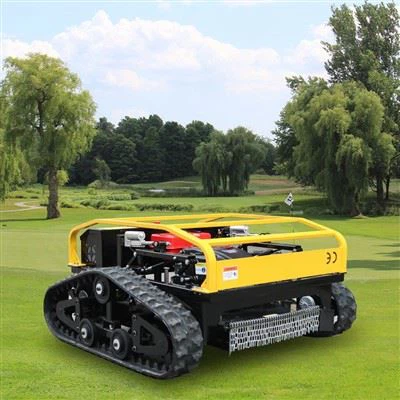
In recent years, the demand for efficient and convenient lawn - care solutions has been on the rise. As a supplier of remote mowers, I've witnessed firsthand the growing interest in automation within the lawn - mowing industry. The question that often comes up is: Can a remote mower be programmed to mow automatically? In this blog, I'll delve into the technical aspects, benefits, limitations, and the future prospects of programming remote mowers for automatic operation.
Technical Feasibility
The short answer is yes, a remote mower can be programmed to mow automatically. Modern technology has provided us with the tools and components necessary to achieve this feat. At the heart of an automatic mowing system is a combination of sensors, controllers, and software.
Sensors play a crucial role in enabling a remote mower to operate autonomously. For instance, GPS sensors can be used to map out the lawn area. By pre - defining the boundaries of the lawn using GPS coordinates, the mower can navigate within the designated area without human intervention. This technology is similar to that used in self - driving cars, where GPS helps the vehicle understand its position in relation to the surrounding environment.
In addition to GPS, other sensors such as ultrasonic sensors and infrared sensors are also employed. Ultrasonic sensors can detect obstacles in the mower's path. When an object is detected within a certain range, the mower can automatically change its direction to avoid a collision. Infrared sensors, on the other hand, can be used to detect the edges of the lawn or other physical boundaries. This ensures that the mower stays within the intended area and doesn't wander off.
The controller is another essential component. It processes the data received from the sensors and makes decisions about the mower's movement. For example, if the GPS sensor indicates that the mower has reached the edge of the pre - defined lawn area, the controller will send a signal to the mower's motor to change its direction. The controller can also adjust the speed of the mower based on the terrain and the density of the grass.


Software is the brain behind the automatic operation of the remote mower. It allows users to program the mower's mowing pattern, schedule, and other parameters. For example, users can set the mower to mow the lawn at a specific time of the day, such as early in the morning or late in the evening. They can also choose different mowing patterns, such as a back - and - forth pattern or a spiral pattern, depending on the shape and size of the lawn.
Benefits of Automatic Mowing
There are several benefits to programming a remote mower for automatic operation. Firstly, it offers convenience. With an automatic mower, users no longer have to spend hours pushing a heavy mower around the lawn. They can simply set the mower's parameters and let it do the job. This is especially useful for people with large lawns or those who have limited time due to work or other commitments.
Secondly, automatic mowing can lead to a more consistent and professional - looking lawn. The mower can be programmed to mow the lawn at a regular interval, ensuring that the grass is always at an optimal length. This helps to promote healthy grass growth and gives the lawn a neat and tidy appearance.
Thirdly, it can improve safety. Remote mowers are often used in areas where there are potential hazards, such as steep slopes or near water bodies. By programming the mower to operate automatically, the risk of accidents can be significantly reduced. The mower's sensors can detect obstacles and avoid dangerous areas, protecting both the mower and the user.
Limitations
However, programming a remote mower for automatic operation also has its limitations. One of the main challenges is dealing with complex terrains. While modern sensors can detect obstacles and boundaries, they may struggle in areas with uneven ground, thick vegetation, or sudden drops. For example, a mower may have difficulty navigating through a heavily wooded area or a lawn with a lot of rocks and debris.
Another limitation is the reliance on technology. If the GPS signal is weak or the sensors malfunction, the mower may not operate as intended. This can lead to the mower getting stuck, going off - course, or even causing damage to the lawn or other property. Additionally, software glitches can also occur, which may require technical expertise to fix.
Our Remote Mower Offerings
As a remote mower supplier, we offer a range of products that can be programmed for automatic operation. Our Remote Control Rotary Lawn Mower Automatic Robot Lawnmower is equipped with advanced sensors and a powerful controller. It can be easily programmed to mow in a variety of patterns and at different times. The rotary blades ensure a clean and precise cut, making it suitable for both small and large lawns.
Our Remote Control Flail Mower is another excellent option for automatic mowing. The flail blades are designed to handle thicker and tougher grass, making it ideal for rough terrains. It also has a robust sensor system that can detect obstacles and adjust its path accordingly.
For those looking for a more general - purpose remote mower, our Remote Control Mower is a great choice. It combines the features of both rotary and flail mowers and can be programmed to meet the specific needs of different lawns.
The Future of Automatic Remote Mowers
The future of automatic remote mowers looks promising. As technology continues to advance, we can expect to see even more sophisticated sensors and software. For example, artificial intelligence (AI) may be integrated into the mower's system. AI can enable the mower to learn from its environment and make more intelligent decisions. It can analyze the grass type, density, and growth rate, and adjust the mowing pattern and speed accordingly.
In addition, the development of more powerful and long - lasting batteries will also improve the performance of automatic remote mowers. This will allow the mowers to operate for longer periods without the need for frequent recharging.
Conclusion
In conclusion, a remote mower can indeed be programmed to mow automatically. Thanks to the advancements in sensor technology, controllers, and software, automatic mowing is becoming a reality for many lawn owners. While there are still some limitations, the benefits of convenience, consistency, and safety make it an attractive option.
If you're interested in learning more about our remote mowers or are considering purchasing one for your lawn, we encourage you to contact us for a detailed discussion. Our team of experts is ready to assist you in finding the right mower for your needs and answering any questions you may have.
References
- Smith, J. (2020). "Advancements in Lawn Mower Technology". Journal of Outdoor Equipment.
- Johnson, A. (2021). "The Future of Automatic Lawn Mowing". Landscape Management Magazine.