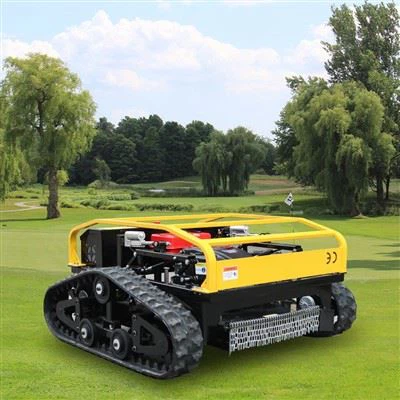
Hey there! As a supplier of remote mowers, I often get asked if these nifty machines can be used in areas with lots of obstacles. Well, let's dive right into it and find out.
First off, what exactly is a remote mower? It's a lawn - cutting device that you can control from a distance. There are different types, like the Remote Control Grass Cutter and the Remote Control Lawn Mower With Tracks. These mowers offer a great deal of flexibility, especially when compared to traditional push - mowers.
When it comes to areas full of obstacles, the answer isn't a simple yes or no. It depends on several factors.
Maneuverability
One of the key features of a remote mower is its ability to move around. Most modern remote mowers are designed with high - precision controls. You can make sharp turns, reverse easily, and navigate through tight spaces. For example, the Remote Control Lawn Mower With Tracks has excellent traction. The tracks allow it to move smoothly over uneven terrain and around obstacles like tree stumps and large rocks.
However, the size of the mower matters. If the mower is too big, it might have trouble getting through narrow gaps between obstacles. Smaller remote mowers, on the other hand, are more agile and can access those hard - to - reach areas. But they might have a smaller cutting width, which means it'll take longer to mow a large area.
Sensor Technology
Many remote mowers these days come equipped with advanced sensor technology. These sensors can detect obstacles in the mower's path. When the mower gets close to an object, the sensors send a signal to the control system, and the mower can either stop or change its direction.
For instance, some Robotic Lawn Mower models use infrared sensors or ultrasonic sensors. Infrared sensors work by emitting infrared light and measuring the reflection. If an object is in the way, the reflection pattern changes, and the mower knows to avoid it. Ultrasonic sensors, on the other hand, use sound waves to detect obstacles. They're quite effective, especially in low - light conditions.
But sensors aren't perfect. They can sometimes be fooled by things like tall grass or small branches. Also, if the obstacle is very low to the ground, the sensors might not detect it. So, while sensor technology helps a lot, you still need to keep an eye on the mower when it's working in an area with many obstacles.
Cutting Ability
Another important aspect is the mower's cutting ability around obstacles. You want a mower that can get close to the edges of obstacles without getting damaged. Some remote mowers have a special blade design that allows them to cut right up to the edge of a tree or a fence.


However, if the obstacle has a complex shape, like a winding garden statue or a cluster of small bushes, it can be a challenge for the mower. In such cases, you might need to do some manual trimming after the mower has done the bulk of the work.
Terrain and Obstacle Types
The type of terrain and obstacles in the area also plays a big role. If the obstacles are just a few scattered rocks and small tree stumps on a relatively flat lawn, a remote mower should be able to handle it. But if the area has steep slopes, deep ditches, or thick underbrush, it becomes more difficult.
Steep slopes can be a problem because the mower might lose traction or tip over. Some remote mowers are designed to handle slopes better than others. For example, mowers with a low center of gravity and good traction control are more stable on slopes.
Thick underbrush can clog the mower's blades and reduce its cutting efficiency. You might need to clear some of the underbrush manually before using the remote mower.
Operator Skill
Let's not forget about the operator. Using a remote mower in an area with many obstacles requires some skill. You need to be able to anticipate the mower's movements and react quickly when it encounters an obstacle.
Practice makes perfect. If you're new to using a remote mower, start with a simple area and gradually work your way up to more challenging terrain. Familiarize yourself with the mower's controls and learn how to make the most of its features.
Safety Considerations
Safety is always a top priority when using a remote mower in an area with obstacles. Make sure to clear the area of any loose objects that could be thrown by the mower's blades. Also, keep bystanders and pets away from the mowing area.
If the mower has a safety switch or an emergency stop button, make sure you know how to use it. In case of an unexpected situation, you can quickly stop the mower to prevent any accidents.
Conclusion
So, can a remote mower be used in areas with many obstacles? The answer is yes, in most cases. With the right mower, advanced sensor technology, and a skilled operator, you can effectively mow areas full of obstacles. However, it's important to understand the limitations of the mower and take appropriate safety measures.
If you're interested in purchasing a remote mower for an area with obstacles, we're here to help. We offer a wide range of Remote Control Grass Cutter, Remote Control Lawn Mower With Tracks, and Robotic Lawn Mower models. Our team can provide you with all the information you need to make the right choice. Reach out to us for more details and let's start a conversation about your mowing needs.
References
- Lawn Care Equipment Handbook: This handbook provides in - depth information about different types of lawn mowers and their capabilities.
- Remote Mower Manufacturer's Manuals: The manuals from various remote mower manufacturers offer valuable insights into the features and limitations of their products.