Can a Remote Mower Be Used on Lawns with a Lot of Rocks?
As a supplier of remote mowers, I often get asked whether our products can be effectively used on lawns with a significant number of rocks. This is a valid concern, as rocky lawns present unique challenges that can impact the performance and longevity of a mower. In this blog post, I'll delve into this topic, exploring the capabilities of remote mowers in rocky environments, the factors to consider, and the precautions to take.
Understanding Remote Mowers
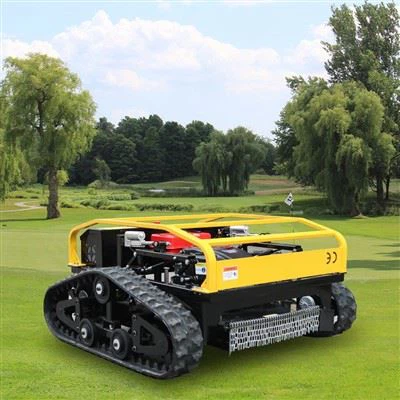
Before we discuss the suitability of remote mowers for rocky lawns, let's briefly understand what remote mowers are. A Remote Control Mower allows the operator to control the mower from a distance using a remote control device. This feature provides enhanced safety and maneuverability, especially in challenging terrains. Some remote mowers, such as the Remote Control Lawn Mower With Tracks, are equipped with tracks instead of wheels, which offer better traction and stability on uneven ground.
Challenges of Mowing Rocky Lawns
Lawns with a lot of rocks pose several challenges for any mower, including remote mowers. Firstly, rocks can cause significant damage to the mower's blades. When the blades hit a rock, they can become dull, chipped, or even break. This not only affects the cutting performance but also increases the maintenance cost as the blades need to be replaced more frequently.
Secondly, rocks can disrupt the mower's movement. If a mower gets stuck on a rock, it can cause the engine to stall or damage the drive system. This can be particularly problematic for remote mowers, as the operator may not be able to quickly access the mower to free it.
Thirdly, rocks can create an uneven surface, which can make it difficult for the mower to maintain a consistent cutting height. This can result in an unevenly mowed lawn, which is not aesthetically pleasing.
Capabilities of Remote Mowers on Rocky Lawns
Despite the challenges, remote mowers have several features that make them suitable for rocky lawns. One of the main advantages is the ability to control the mower from a distance. This allows the operator to avoid large rocks and other obstacles more easily, reducing the risk of damage to the mower.


Remote mowers with tracks, such as the Remote Control Lawn Mower With Tracks, offer better stability and traction on rocky terrain. The tracks distribute the mower's weight more evenly, reducing the likelihood of getting stuck on rocks. Additionally, the tracks can help the mower navigate over small rocks and uneven surfaces more smoothly.
Some remote mowers are also equipped with heavy-duty blades that are more resistant to damage from rocks. These blades are made from high-quality materials and are designed to withstand the impact of hitting a rock without breaking or chipping easily.
Factors to Consider
When deciding whether to use a remote mower on a rocky lawn, there are several factors to consider. Firstly, the size and density of the rocks are important. If the rocks are large and numerous, it may be more difficult for the mower to operate effectively. In such cases, it may be necessary to remove some of the larger rocks before mowing.
Secondly, the type of grass on the lawn can also affect the mower's performance. Some types of grass are more resilient to rocky conditions and can tolerate being mowed on uneven surfaces. Others may be more delicate and require a smoother surface for a clean cut.
Thirdly, the operator's skill level is crucial. Operating a remote mower on a rocky lawn requires more skill and attention compared to a flat, rock-free lawn. The operator needs to be able to accurately control the mower's movement and avoid hitting rocks.
Precautions to Take
To minimize the risk of damage to the remote mower and ensure a successful mowing experience on a rocky lawn, several precautions should be taken. Firstly, it's important to inspect the lawn before mowing and remove any large or loose rocks. This can help prevent the mower from hitting the rocks and causing damage.
Secondly, the mower's blades should be regularly inspected and sharpened. Dull blades are more likely to cause damage when they hit a rock, so keeping them sharp can reduce the risk of blade breakage.
Thirdly, the operator should start the mowing process slowly and carefully, especially in areas with a high concentration of rocks. This allows the operator to better identify and avoid obstacles.
Fourthly, it's a good idea to use a mower with a higher ground clearance. This can help prevent the mower from getting stuck on rocks and reduce the risk of damage to the undercarriage.
Conclusion
In conclusion, while mowing a lawn with a lot of rocks is challenging, remote mowers can be used effectively in such environments. Their ability to be controlled from a distance, combined with features like tracks and heavy-duty blades, makes them suitable for navigating rocky terrain. However, it's important to consider the size and density of the rocks, the type of grass, and the operator's skill level. By taking the necessary precautions, such as inspecting the lawn, maintaining the blades, and mowing carefully, a remote mower can provide a reliable and efficient solution for mowing rocky lawns.
If you're considering purchasing a remote mower for your rocky lawn, I encourage you to reach out to us. We have a wide range of Remote Control Mowers and Robotic Lawn Mowers that are designed to handle various terrains, including rocky lawns. Our team of experts can provide you with more information and help you choose the right mower for your needs. Contact us today to start a discussion about your lawn mowing requirements.
References
- "Lawn Mower Maintenance Guide," Lawn Care Association of America.
- "Remote Control Mowers: Features and Benefits," Mower Technology Journal.
- "Mowing on Uneven Terrain: Best Practices," Landscape Management Magazine.