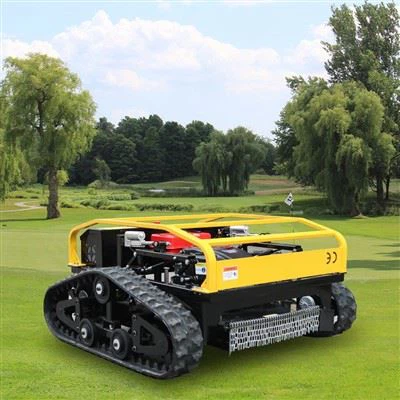
In recent years, the advancements in lawn - care technology have introduced remote mowers as a revolutionary solution for maintaining various types of landscapes. As a leading remote mower supplier, we often receive inquiries from customers about the feasibility of using our remote mowers in areas with underground cables. This blog aims to explore this question in depth, providing a comprehensive analysis based on scientific and practical aspects.
Understanding Remote Mowers
Remote mowers, such as our Remote Control Lawn Mower With Tracks and Remote Control Mower, are equipped with advanced control systems that allow operators to manage the mowing process from a distance. These mowers come with tracks, which provide excellent traction and maneuverability on different terrains, making them suitable for a wide range of applications.


The design of remote mowers focuses on efficiency and safety. They are usually powered by reliable engines or electric motors, and the cutting mechanisms are engineered to deliver a clean and even cut. The remote - control feature not only enhances the user's convenience but also enables operation in areas that might be difficult or dangerous to access directly.
Potential Risks in Areas with Underground Cables
When considering using a remote mower in areas with underground cables, there are several potential risks that need to be carefully evaluated.
Physical Damage
The tracks of a remote mower can exert significant pressure on the ground. If the mower passes over an area where underground cables are located, there is a risk of physical damage to the cables. The weight of the mower and the movement of the tracks could potentially crush or puncture the cable sheaths, leading to service disruptions, electrical hazards, and costly repairs.
Electrical Interference
Some remote mowers operate using electronic control systems. In the presence of underground power cables, there is a possibility of electrical interference. The electromagnetic fields generated by the cables could disrupt the signal between the remote control and the mower, causing the mower to malfunction or behave unpredictably. This interference could also affect the internal electronics of the mower, leading to component failures over time.
Mitigating the Risks
Despite the potential risks, it is possible to use remote mowers in areas with underground cables by implementing appropriate mitigation strategies.
Cable Mapping
Before using a remote mower in an area, it is essential to obtain accurate cable maps. These maps can be obtained from the local utility companies or through professional cable - locating services. By knowing the exact location of the underground cables, operators can mark the areas on the ground and program the mower's path to avoid these sensitive areas. Our Remote Control Lawn Mower With Tracks can be easily programmed to follow specific routes, allowing for precise operation in areas with underground cables.
Sensor Technology
Equipping the remote mower with advanced sensor technology can significantly reduce the risk of cable damage. For example, proximity sensors can be installed on the mower to detect the presence of underground objects. When the sensors detect an object at a certain depth, the mower can be programmed to automatically stop or change its course. This technology can provide an extra layer of protection for the underground cables and enhance the safety of the mowing operation.
Operator Training
Proper operator training is crucial when using remote mowers in areas with underground cables. Operators should be educated about the potential risks associated with underground cables and trained to use the mower's controls and safety features effectively. They should also be familiar with the cable - mapping process and the procedures for dealing with unexpected situations, such as sensor alarms or signal interference.
Case Studies
There have been several successful cases of using remote mowers in areas with underground cables. For instance, in a large industrial park, the management needed to maintain the lawn areas around the buildings where there were extensive underground electrical and communication cables. By using our remote mower and following a strict cable - mapping and safety protocol, the lawn was maintained without any incidents of cable damage. The operator was able to efficiently control the mower from a safe distance, ensuring precise cutting while avoiding the cable areas.
Another case involved a residential neighborhood with underground power and fiber - optic cables. The homeowners' association decided to use a remote mower to maintain the common lawn areas. After obtaining the cable maps and providing proper training to the operators, the mower was used to keep the lawns in excellent condition. The advanced sensor technology on the mower helped to prevent any accidental damage to the cables, and the remote - control feature allowed for quick adjustments to the mowing path as needed.
Conclusion
In conclusion, while there are risks associated with using a remote mower in areas with underground cables, it is indeed possible to do so safely and effectively. By taking appropriate precautions, such as cable mapping, using sensor technology, and providing operator training, the potential damage to cables can be minimized. Our company offers a range of high - quality remote mowers, including Remote Control Lawn Mower With Tracks and Remote Control Mower, which are designed to meet the needs of various applications.
If you are interested in purchasing remote mowers for your lawn - care needs, especially in areas with underground cables, we encourage you to contact us for further discussion. Our team of experts is ready to provide you with detailed information, technical support, and customized solutions. Let us work together to find the best remote mower for your specific requirements.
References
- "Best Practices for Operating Machinery Near Underground Utilities," Utility Safety Institute.
- "Remote - Controlled Lawn Mower Technology: Advancements and Applications," Journal of Agricultural and Landscape Automation.