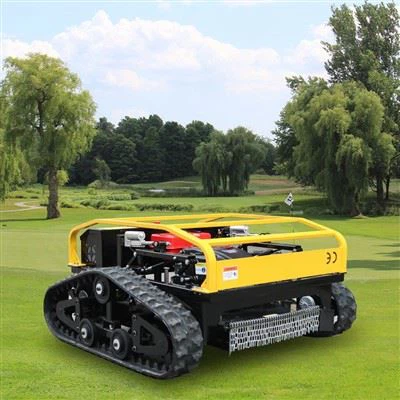
In the realm of lawn care and maintenance, the advent of advanced mowing technologies has revolutionized the way we approach grass cutting. Two prominent players in this field are remote mowers and automated mowers. As a supplier of remote mowers, I am well - versed in the nuances that set these two types of mowers apart. In this blog, I will delve into the differences between remote mowers and automated mowers, exploring their features, advantages, and ideal use cases.
How They Operate
The most fundamental difference between remote mowers and automated mowers lies in their operation mechanisms.
A remote mower, as the name suggests, is controlled by a user from a distance using a remote control device. This gives the operator direct control over the mower's movements, speed, and cutting functions. For instance, if there are obstacles in the lawn, such as large rocks, flower beds, or play equipment, the operator can easily maneuver the mower around them. The remote control provides real - time control, allowing for quick adjustments as needed. Take our Remote Control Grass Cutter as an example. It offers precise control, enabling users to cut grass in areas with complex terrain, like sloped lawns or areas with irregular shapes.
On the other hand, an automated mower operates independently based on pre - programmed settings. These mowers are typically equipped with sensors and navigation systems that allow them to move around the lawn, avoid obstacles, and follow a pre - determined mowing pattern. Once set up, the automated mower will start and stop at the designated times, and it will continue to mow the lawn until the task is completed. However, the level of autonomy means that it may not be as adaptable to sudden changes in the environment as a remote mower.
Cutting Precision and Flexibility
When it comes to cutting precision, both types of mowers have their strengths.
Remote mowers offer high precision in cutting, especially in areas that require detailed work. Since the operator has direct control, they can ensure that the grass is cut at the desired height and in the desired pattern. For example, in a golf course where the grass needs to be cut at different heights for fairways, roughs, and greens, a remote mower can be used to achieve the exact specifications. The flexibility of a remote mower also allows for selective cutting. If there are patches of weeds or overgrown grass in a particular area, the operator can focus on those spots and give them extra attention. Our Remote Control Lawn Mower With Tracks is designed to provide stable and precise cutting, even on uneven terrain.
Automated mowers, while also capable of achieving a relatively uniform cut, are more limited in their flexibility. They follow a set pattern, and it can be difficult to make on - the - fly adjustments. For example, if there is a new obstacle that appears on the lawn after the mower has been programmed, the automated mower may struggle to avoid it effectively. However, they are excellent for large, open lawns with few obstacles, where a consistent and regular cut is required.
Safety Features
Safety is a crucial aspect of any lawn mower.
Remote mowers come with several safety features that are related to their mode of operation. Since the operator is at a safe distance from the mower, there is less risk of being injured by the moving blades. Additionally, most remote mowers have emergency stop buttons on the remote control, allowing the operator to immediately halt the mower's operation in case of an emergency. Some remote mowers also have sensors that can detect when the mower is tilted beyond a certain angle or when it comes into contact with an object, which will automatically stop the blades.
Automated mowers also have safety features, such as sensors to detect obstacles and stop the mower before a collision. They often have a safety switch that stops the blades if the mower is lifted or tilted. However, because they operate autonomously, there is a potential risk that the sensors may malfunction or fail to detect an unexpected obstacle, which could lead to an accident.
Cost and Maintenance
Cost is an important consideration for anyone in the market for a lawn mower.


Remote mowers generally tend to be more expensive upfront. This is because they often come with advanced remote control technology and more robust construction to withstand the rigors of manual operation. However, the long - term cost may be offset by their durability and the ability to use them in a wider range of applications. Maintenance of remote mowers usually involves regular checks of the remote control, the engine (if it is a gas - powered mower), and the cutting blades. Since the operator has more control over the mower's movements, they can also take better care to avoid damage to the equipment.
Automated mowers are often more affordable initially, especially for smaller models. However, they may require more frequent maintenance due to their complex sensors and navigation systems. If a sensor fails or the navigation system malfunctions, it can be costly to repair. Additionally, some automated mowers rely on a boundary wire to define the mowing area, and if this wire is damaged, it can disrupt the mower's operation.
Ideal Use Cases
The choice between a remote mower and an automated mower depends largely on the specific needs of the user.
Remote mowers are ideal for large commercial properties, such as parks, sports fields, and industrial sites. Their ability to handle complex terrain and make precise cuts makes them suitable for areas with a lot of obstacles or areas that require detailed work. They are also a great choice for lawns with slopes, as the operator can control the mower's speed and direction to ensure safe and effective cutting. Our Remote Grass Mower is well - suited for such applications.
Automated mowers are best for residential lawns that are relatively small and flat, with few obstacles. They are convenient for homeowners who want a hands - off approach to lawn care. The ability to program the mower to mow at specific times means that the lawn can be kept in good condition without the homeowner having to spend time operating the mower.
Conclusion
In conclusion, remote mowers and automated mowers each have their own unique features, advantages, and disadvantages. Remote mowers offer greater control, flexibility, and precision, making them suitable for complex and large - scale lawn care tasks. Automated mowers, on the other hand, provide convenience and are a good choice for simple, small - to - medium - sized residential lawns.
If you are in the market for a high - quality remote mower that can meet the demands of your specific lawn care needs, we are here to help. Our range of remote mowers is designed to provide reliable performance, precise cutting, and long - term durability. Whether you have a large commercial property or a challenging residential lawn, our remote mowers can get the job done. Contact us today to discuss your requirements and explore how our products can benefit you.
References
- Various industry reports on lawn mower technology and market trends.
- Manufacturer's specifications and user manuals for remote and automated mowers.